

Kushiel’s Dart by Jacqueline Carey is a historical fantasy novel set in an alternate version of Western Europe where the blood of Yeshua ben Josef (Jesus Christ) mixed with the tears of the Magdalene and the spirit of the Earth to produce Elua, the Messiah+, who instead of human disciples had a bunch of angels descended from Heaven that followed him from Tiberium (Rome) to Terre d’Ange (France). One of those angels, Naamah, was a sex worker who slept with kings and peasants to secure passage and shelter for the companions. Another, Kushiel, is the god of punishment and angel of the rod who chastises his followers as an act of love and mercy. These are the two gods most relevant to the life of the protagonist, Phèdre.
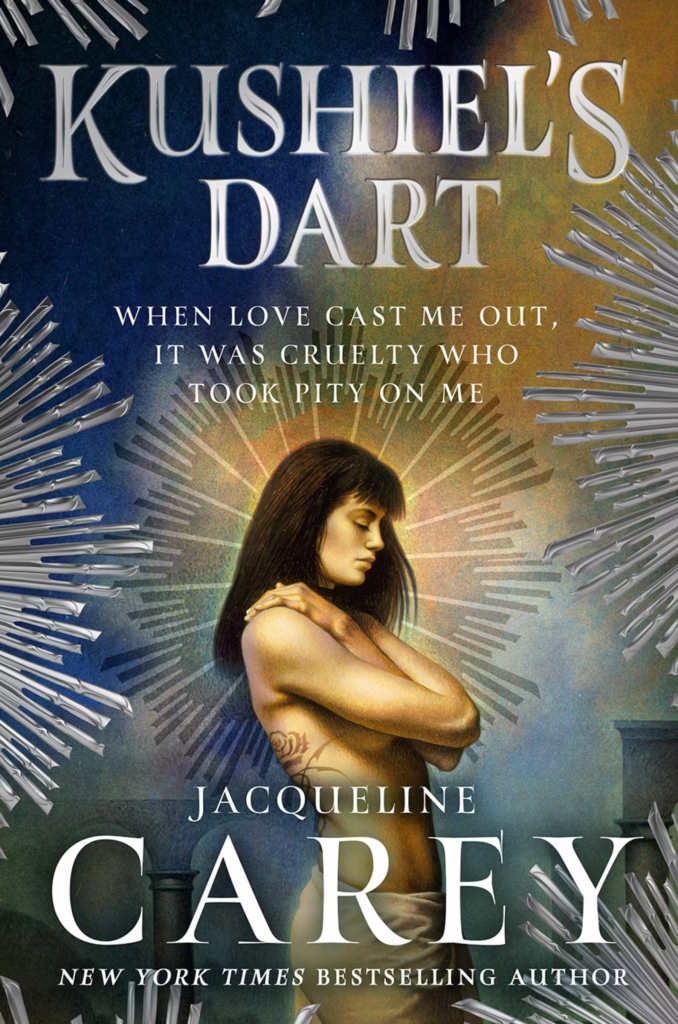
When I cracked open the first few pages of Kushiel’s Dart, I shared a few excerpts with my friends. The prose has a certain quality one might assign as purple if feeling uncharitable, though as a long-time Lovecraft reader I can’t bring myself to see the word as an insult and never use it as such. The prose is rich, vibrant, imaginative, and terribly obsessed with beauty.
It is not, of course, that I lacked beauty, even as a babe. I am a D’Angeline, after all, and ever since Blessed Elua set foot on the soil of our fair nation and called it home, the world has known what it means to be D’Angeline. My soft features echoed my mother’s, carved in miniature perfection. My skin, too fair for the canon of Jasmine House, was nonetheless a perfectly acceptable shade of ivory. My hair, which grew to curl in charming profusion, was the color of sable-in-shadows, reckoned a coup in some of the Houses. My limbs were straight and supple, my bones a marvel of delicate strength.
No, the problem was elsewhere.
To be sure, it was my eyes; and not even the pair of them, but merely the one.
Such a small thing on which to hinge such a fate. Nothing more than a mote, a fleck, a mere speck of color. If it had been any other hue, perhaps, it would have been a different story. My eyes, when they settled, were that color the poets call bistre, a deep and lustrous darkness, like a forest pool under the shade of ancient oaks. Outside Terre d’Ange, perhaps, one might call it brown, but the language spoke outside our nation’s bounds is a pitiful thing when it comes to describing beauty. Bistre, then, rich and liquid-dark; save for the left eye, where in the iris that ringed the black pupil, a fleck of color shone.
And it shone red, and indeed, red is a poor word for the color it shone. Scarlet, call it, or crimson; redder than a rooster’s wattles or the glazed apple in a pig’s mouth.
The book is practically daring you to call it florid, so that it may in turn call you a dullard. Yes, there are simpler ways these concepts could be written, but what virtue is simplicity? It is a book that loves beauty, and so it shall convey that love as loudly as it can, in every line of prose, for as long as you’ll have it.
The opening pages of Kushiel’s Dart are remarkably compelling for being, in essence, some three chapters of backstory, or six, or perhaps even twenty depending on how you wish to cut it. It’s common writing advice in online circles that you should start your story as close to the action as possible and elide anything that might dare resemble a prologue. The idea of starting your story at the birth of the protagonist is laughable enough that it’s been mocked with web fiction that places the start in the mother’s womb and keeps it there (the Wombsekai, I’ve seen it called). It’s far from a universal rule, though, and I certainly did not begrudge this tale the leisure of its first act.
Phèdre communicates a great deal of explicit and implicit information in the early chapters. She tells us that she is of noble stock, that she was sold as a small child to be raised and trained as an adept of the Court of Night-Blooming Flowers (a courtesan, escort, or high-class prostitute, in other words), and that she is cursed and blessed with the personal attention of a D’Angeline god; she bears the titular mark, Kushiel’s Dart, which renders pain as pleasure and ensures her body will always recover unscarred from the wounds her patrons leave. For this, she is named an anguisette.
Phèdre is a slave, though she would insist that “debt-bondage” cannot be compared to true slavery. Indeed, though her life belongs to another and she must ply her trade as an adept to earn her freedom, nothing that is done to her in the first third of the book is done without her consent. The central precept of the D’Angeline religion, “Love as thou wilt,” casts rape as crime and heresy both. An adept always has final say over what contracts they accept, though of course an adept that’s too picky isn’t exactly paying off their debt; it’s never made clear what consequences such an adept might face, as our viewpoint character is rather the opposite of bed-shy. In the case of adepts who take rougher clients, like Phèdre, the D’Angelines even have the concept of a safeword, though they call it something fancier.
“It is something they have devised at Valerian House; I spoke to their Dowayne at some length, to learn what was needful. Betimes a patron goes too far in the throes of transport. You know that protestation is part of the game, yes? The signale is beyond that. It is a word, if spoken, that halts all play. You must have one, Phèdre.” His gaze grew serious. “If a patron fails to heed the signale , he or she is guilty of heresy. It is your safeguard against injury, against violating the precept of Blessed Elua. They say it is best to choose a word that cannot be mistaken for loveplay. Do you wish to think on it?”
Kushiel’s Dart is an interesting book to chew on. I fear that many will hear of its contents and mistake it for lurid erotica and nothing more, but I also can’t abide dismissing its more sexual aspects as distraction from its intrigue games and deep character stories. It is a book that understands BDSM and depicts BDSM realistically, and it weaves those scenes of kinky eroticism together with the thriller tension of spycraft and the heartwrenching drama of literary romance.
When sex is described, it is hot, absolutely, but it’s also usually being paired with an intrigue question like “Will this target reveal something important?” or “Will Phèdre’s deceptions be uncovered?” Phèdre’s clients are wealthy, dangerous, influential people in the complicated web of Terre d’Ange politics, and she is being employed not just as a courtesan but as a spy for her master, Anafiel Delaunay, in teasing out the secrets of various conspiracies that swirl around the throne of the kingdom and its slow succession crisis.
Delaunay is critical to shaping Phèdre’s development and sense of identity. The matron of the House that Phèdre is sold to calls her “a whore’s unwanted get,” which is what Phèdre perceives herself as until she meets Delaunay and hears him put a name to Kushiel’s Dart. Looking back on that moment, she later remarks that, “it had been he who, with two words, turned my deadliest flaw to a treasure beyond price.”
More dangerously, it is Delaunay who teaches her how to look, listen, and think. Anafiel Delaunay is a disgraced poet, a friend to the Crown, and the Whoremaster of Spies. He takes in two children born of unfortunate circumstances and ensures they are taught all the skills they need to move among the elite of Terre d’Ange and extract vital intelligence. Under his tutelage, Phèdre and her fellow ward, Alcuin, blend guile and allure to entice the aristocracy into giving up names they really, really shouldn’t.
Delaunay is an interesting character, and one who Phèdre is probably softer on than he deserves. His attempts to hide his past from her almost certainly lead to his demise, and for all that he prizes the consent of his pupils, he doesn’t seem to have gotten the memo that sleeping with one of them definitely counts as grooming. That would be Alcuin, by the way, and not Phèdre, which she get briefly but furiously jealous about. Alcuin is in love with Delaunay, very sweet and romantic, blah blah, I didn’t really care for that subplot and I’m not going to linger on it or on the character of Alcuin, who is largely present as a foil for Phèdre; he’s the pretty boy that gets his virginity sold for a deluge of ducats and doesn’t actually like being a prostitute but does it because he’s in love with Delaunay, who saved him and took him in after his village was destroyed by raiders, and this also ultimately contributes to his and Delaunay’s deaths.
Ironically, for all that the intrigue drives the book, I can’t bring myself to care overmuch about the details. I could recite Delaunay’s history with the prince he was in love with and the murders of that prince’s wives and how that led to Delaunay swearing an oath of loyal service to the prince’s daughter, but… meh? Like, it’s good stuff, very well done, strong motivation, but it’s not what I’m here for and I think most of the politicking in the book is carried by Phèdre getting naked and sucking someone off before they hit her with a bladed whip. Your mileage may vary.
I like the setting! It’s a low fantasy world where thought is put into the daily lives of peasantry and nobility alike, and I think that’s done well. It’s a rich setting, though some of that is being bolstered by the AU Earth nature of it; when the splintering of Tiberium is mentioned, I don’t need paragraphs of worldbuilding to understand they’re talking about Rome. I do think its approach to magic is oddly refreshing, though that’s largely a consequence of my reading habits; I’m used to stories where everyone gets to throw around fireballs and teleports and the ten thousand sacred swords of the burning heavens. Here, magic is usually subtle or beyond the ken of mortals. I could describe part of the protagonist’s blessing as a low-level healing factor, but that almost feels disrespectful to the story. The dromonde of the Tsingano fortunetellers, which allows them to pierce the veil of the future in flashes of insight, is an art that could be mistaken for mere cold reading until later events prove it direly accurate. It isn’t until we meet the Master of the Straits, who controls the waves between Terre d’Ange and Alba, that we see the kinds of impressive feats of sorcery that in a more D&D-esque story would be commonplace.
Hmm, is that enough dissembling about the rest of the book? Yes, I think it is. Strap in, dear reader, because it’s time to talk about what really got me interested in this one. It’s time to talk about Melisande.
Melisande Shahrizai Did Nothing Wrong
I adore Melisande. She’s awful, she’s vicious, she’s sex personified, she’s my perfect little monster and I wish her only the best until she is inevitably buried under the consequences of her many, many actions.
So who is Melisande?
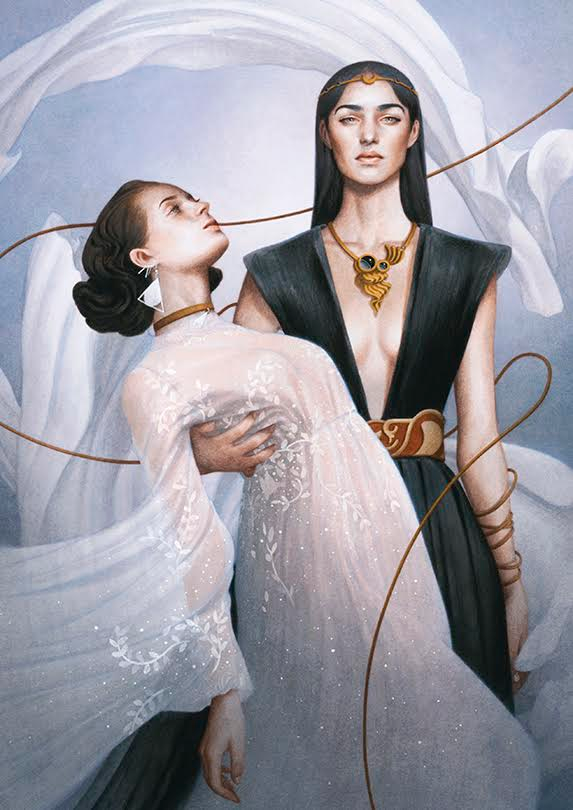
That’s Melisande on the right. This is from the sequence where she dresses Phèdre in a gown of gauze and diamonds that leaves nothing to the imagination and parades her around by collar and lead through a gala packed with the nobility of the nation. The lords and ladies of Terre d’Ange get to look and touch as Melisande displays her pet for the whole court, which makes Phèdre so horny that she completely fails to remember anything about the evening (a task she usually prioritizes, being a spy) except for every minute detail of Melisande’s expressions and body language during the event. It’s a breathtaking night, made even more enchanting when Phèdre is taken to Melisande’s personal quarters, parted from her diamond gown with a steel flechette, and cut across the whole of her body until at last she gasps her signale and climaxes on the spot.
A few days later, Anafiel Delaunay is murdered by Melisande’s co-conspirator acting on information that Melisande obtained by using Phèdre’s name as bait. When Phèdre runs to the palace, Melisande intercepts her, drugs her, and sells her as a slave to the raiders of the north. Phèdre knows too much to remain, but Melisande can’t bear to see her destroyed. Slavery, then, will satisfy as compromise.
The Night Court taught me to serve, and Delaunay taught me to think; but from Melisande Shahrizai, I learned how to hate.
Melisande, Melisande, Melisande. It’s often said that a villain is what really makes a story, and that was truly the case here. Melisande is what elevates Kushiel’s Dart from a fantasy intrigue of passing skill to a masterpiece worthy of obsession.
Melisande is a shadow in the narrative long before her first appearance. She is mentioned in Chapter Three as someone who will identify Kushiel’s Dart as swiftly as Delaunay, and then again in Chapter Five as someone that Delaunay was a fool to ever trust, both times framing her in contrast to Phèdre’s mentor. It’s in Chapter Seven that Melisande is described properly, and if you think it’s weird that I’m only now beginning to highlight chapter-by-chapter details then you’re wrong and I’m normal and this is a healthy, ordinary, completely scholarly interest.
Melisande is identified as Delaunay’s sole rival in the game of shadows. They see each other as peers in a way none of the peerage can aspire to, fellow geniuses and artists who crave an audience for their deeply-laid schemes. She is also, the book makes clear, exceedingly beautiful.
To describe Melisande Shahrizai is, as the poets say, to paint a nightingale’s song; it is a thing which cannot be done.
Personally, I think “the baddest bitch in Terre d’Ange” is a description that would make the poets weep, but what do I know? My friend read that commentary and said it would make the poets weep to see language wielded like one would use a particularly dull rock, which is a good line but he stole it from Kill Six Billion Demons so points off for lack of originality. Never call me a hypocrite.
Jacqueline Carey’s prose is great, by the way, just need to reiterate that. She a great job of conveying that whatever you think of Melisande’s physical traits, you should believe that the characters believe that she is the most beautiful woman any of them have ever seen. Ultimately, it isn’t her physical beauty that makes her so enchanting; it’s her presence, her behavior, her body language. She trails her fingers across Phèdre’s skin and makes her shiver with the unavoidable truth that they are made for each other like lock and key or lash and back. The anguisette and the sadist, the scion of Kushiel’s line and the recipient of Kushiel’s Dart. They are destined.
Because I am a rank amateur with no formal training in media analysis, my constant fallback is to the few pieces of learning I’ve picked up from endlessly rewatching the video essays of a small handful of content creators on YouTube. So, let me assure you, I do understand that the Kuleshov Effect is entirely the wrong term to use when describing the sequencing of scenes in a novel, but that’s the term I’m familiar with, dammit, so that’s what guides my framing. I notice how these details fit together and my brain dings “oh, Kuleshov Effect!” and then I scribble my little notes like the dabbler I am.
So, information by contrast. In the paragraphs leading up to Melisande’s formal introduction, Phèdre narrates how Delaunay has carefully placed his other ward, Alcuin, before the nobility of Terre d’Ange in a variety of situations where they can look but not touch. He has done this “to set the wheels of desire in motion long before the day would arrive,” and we see later how successful this is when Alcuin’s virgin-price is auctioned for a truly unreasonable sum. Delaunay baits the nobility with tantalizing, frustrating, inadequate encounters before they are finally granted leave to sample the intimate pleasures of Alcuin’s company.
Then we meet Melisande, who has instant chemistry with Phèdre but teases her only briefly before turning away, and the prior description of Alcuin has primed my brain to read this as Melisande practicing the same strategy. She does this again in Chapter Eighteen after mentions in Chapters Ten and Twelve, flirting with Phèdre verbally and physically before once again cutting the scene short and leaving Phèdre denied. Phèdre sees herself as bait laid for Melisande by Delaunay, but it’s clear from these glimpses that Melisande is working hard to turn herself into equivalent bait for Phèdre.
“Your name is being spoken in certain circles, Phèdre.” Only the tips of her fingers touched me, but she was close enough that her breath was warm on my neck. The amusement in her voice reminded me of Delaunay; nothing else did. “You’ve never given the signale, have you?”
“No.” I breathed the word, unable to summon the strength to speak it.
“I thought not.” Melisande Shahrizai laid her palm flat in the small of my back, where it burned like a brand, then drew it away and did up my buttons, quick and professional. I could hear her smile in the darkness. “Some day we will see which throws truer, Kushiel’s line or Kushiel’s Dart.”
This is one of the central tensions of their relationship, and the heart of what makes their conflict so juicy. Dominant and submissive, sadist and masochist, the lash and the back—destined for each other, yes, but in the end only one can prove triumphant. Who shall win this game of desire?
In Chapter 20, we are informed that Melisande has boatloads of cash and two dead husbands she probably didn’t murder, if only because it’s smarter to marry old men on death’s door than to take the risk of being caught poisoning them. On that note, Melisande invites Delaunay’s household to a birthday party for the next guy she’s seduced, Prince Baudoin de Trevalion, who she has absolutely zero chance of marrying thanks to his mother, the Lioness of Azzalle, being Melisande’s chief rival in the category of “most scheming bitch in the kingdom,” though we’ll learn rather quickly that Melisande is the far superior schemer.
Melisande guides her little boy toy in his drunken pleasure-seeking, finding amusement in goading him to petty cruelties. The second she can slip away from him, she pulls on Phèdre’s hair and kisses her hard before ordering a male courtesan to have the gentlest possible sex with Phèdre, which is basically torture for the girl who gets off on actually being tortured. Melisande is cooking this girl beautifully.
Our delightful villainess and her relationship with the prince is an interesting example of a manipulator and a warrior. Baudoin obviously believes that he holds the power in their relationship, being of higher status and physically imposing, but it’s made very clear to the reader that Melisande is pulling his strings. In Chapter Twenty-One, when Phèdre is given as a gift to Baudoin, he fingers her at the dinner table and fucks her from behind, but it’s Melisande who goads him on—gives him permission to use her like this.
A chair scraped and I heard Melisande rise, knew by the rustle of clothing that she had come around to stand behind him. I could hear her hands slide over the breast of his doublet and knew that she whispered at his ear. “Do it hard, my love,” her rich voice breathed. “I want to watch you make her spend.”
It’s Melisande who directs Baudoin, and it’s Melisande who gives Phèdre permission to climax. When they go to the pleasure chamber, it is Melisande who selects the toys, Melisande who ties Phèdre to the wheel, and Melisande who sees to Phèdre afterward. In that next morning’s conversation, Melisande and Phèdre speak of the game that lies between them, or rather between Melisande and Phèdre’s master, Delaunay. This was a farewell gift, Phèdre intuits.
A week later, Prince Baudoin is put to the sword, him and his mother implicated in treason against the Crown. Their correspondence on the matter had been intercepted by Melisande Shahrizai.
In the aftermath of the execution, Melisande crosses paths with Hyacinthe, who I probably should have mentioned before now but fuck it, here we are. Hyacinthe is Phèdre’s best friend, the self-proclaimed Prince of Travellers, and the son of a Tsingano (read: Romani) fortuneteller that possesses the dromonde, the ability to see the future. When Hyacinthe meets Melisande, a prophecy overtakes him.
“This I will tell you, Star of the Evening,” he said in a cold voice, bowing formally to her, the distant tone of the dromonde in his telling. “That which yields, is not always weak. Choose your victories wisely.”
If ever I had doubted that Melisande Shahrizai was dangerous, I doubted it no more that night, for alone among her kin, she did not laugh and jest, but narrowed her eyes in thought. “Something for nothing, from a Tsingano? That is something indeed. Marmion, pay him, that there be no debt between us.”
Melisande is dangerous because of her cunning and her canniness. In a world ruled by swords, she is a master of subtler arts. Where her kin are blinded by aristocratic arrogance, she heeds the words of the fortuneteller and moves quickly to settle any karmic debts. She is careful. She plays the long game.
It won’t be enough, in the end; for all that she respects the first half of the prophecy, she proves blind to the second. Melisande will overreach, as is her nature, and she will fail. She betrays Terre d’Ange to the king of the Skaldi raiders, Waldemar Selig, fully intending to betray him in turn and become queen of both nations, or at the very least to place a child on the throne of both. When Selig’s invasion fails, she is captured, and on the eve of her execution she speaks with Phèdre one more time.
Her voice, low and honeyed, sent shivers across my skin, and I stood rooted as she crossed the room. Almost idle, one hand traced the line of my marque, hidden beneath my gown; it awakened the wound Selig had dealt me, and pain flared outward, suffusing my body. I could feel the heat of her presence, her scent. Nothing had changed. My will bent before hers as she cupped my cheek with one hand, face rising obediently to hers, my world tilted around her axis. “That which yields,” she murmured, lowering her lips toward mine, “is not always weak.”
A kiss; almost. Her lips brushed mine and withdrew, hands leaving my skin, and I staggered in the abyss of her sudden absence, in a shock of yearning.
Even at the end, after betrayal and slavery and near the ruin of a homeland, Phèdre longs for Melisande like she longs for no one else. She hates her, certainly, and desires pain upon her, but she also loves Melisande and cannot stop herself from loving Melisande.
In the online circles, we call that toxic yuri.
As I assembled my notes for this article, a friend asked me why so much of it circled around Melisande. It was a sincere question; though I certainly find the character attractive, that’s not why I feel compelled to write at such length of her nature. In Melisande and Phèdre there is a beautiful kind of love and hatred that I see so rarely. I find that mixture to be intoxicating.
In the web serial Practical Guide to Evil, one of the central romantic relationships is between Catherine Foundling, the protagonist, and Akua Sahelian, the woman that murdered six digits of Catherine’s countrymen for the sake of a power grab. Though Catherine faces other foes and lies with other lovers, none inspire such intensity as her fated nemesis, Akua. How could they? They are bound to one another, enthralled by one another, ever longing for what cannot be had. Akua is lovely and charming and a murderer whose sins can never be washed from her hands. The hate that Catherine feels for Akua doesn’t detract from her later romantic feelings; rather, it enhances those feelings.
Love and hate are two sides of the same coin, or the same blade, or however you want to cut the metaphor. They are two of the strongest emotions that one can feel, and they cause you to see someone in a different light. Love and hate blind, but they also reveal. The visual novel Umineko presents its central thesis as “Without love, the truth cannot be seen.” I would argue that hate, also, shows a kind of truth.
Catherine and Akua see each other in ways that are impossible for those who lack that depth of texture, just as Melisande and Phèdre come to know each other more intimately through that heady concoction of yearning and spite. In Homestuck, they have a term for such a fated nemesis: kismesis, black romance, which is a kind of hateful desire that drives you to better yourself. There are facets of yourself that you would ignore or deny which only a kismesis can expose, baring the truth of your soul through the blade of hate that cuts where love would dare not tread.
So the Rest of This Book
Thank you for indulging my lesbian obsession. I don’t have a lot to say about the rest of Kushiel’s Dart, but I do think it’s worth at least a few more words. I do highly encourage you to read the book yourself, if you haven’t already, particularly for those Melisande scenes and all the gorgeous details I’ve left out.
Phèdre goes on quite the journey after she’s booted from Terre d’Ange into the grasping arms of slavers. She experiences culture shock among the Skaldi, finding them barbaric, but comes to see through their art and music that they, too, are a people that know beauty, if not in the way of the D’Angelines. She is a loving soul, Phèdre, and her heart aches for the deaths of even those who contributed to her slavery, appreciating the little kindnesses she was shown amid the horror. When she has to flee the northlands on horse and then on foot, she comes to realize how truly sheltered she’s been all her life, needing to be taught the basic fundamentals of survival.
She meets a priest of the Skaldi’s All-Father, Odhinn, who calls her “a weapon thrown by a D’Angeline god.” It’s a startling revelation for Phèdre. Delaunay showed her that she had value, but even as a spy she conceived of herself more as a treasure, something pretty and desirable. As an anguisette, her role is to be harmed, not to harm others. But that which yields is not always weak, and Kushiel has grander designs for his chosen than to be a plaything for the cruel. It is in this spirit that Phèdre nearly murders the king of the Skaldi to save her people, though it would have cost her life.
There’s more to say, truly, but this article is already too long. Read Kushiel’s Dart. It’s good, promise. I’ll be reading the rest of the trilogy as soon as I get my hands on copies, and then I’ll have more to say. If you haven’t read it already, read it! If you have read it, read it again!
Lesbian BDSM toxic yuri! And other stuff! 10/10 great stuff.