

Moon Called by Patricia Briggs is the first novel in the Mercy Thompson series, a broken masquerade setting where some—but not all—of the supernatural creatures in the world have revealed themselves. Here’s the back of the book:
Werewolves can be dangerous if you get in their way, but they’ll leave you alone if you are careful. They are very good at hiding their natures from the human population, but I’m not human. I know them when I meet them, and they know me, too.
Mercy Thompson’s sexy next-door neighbor is a werewolf.
She’s tinkering with a VW bus at her mechanic shop that happens to belong to a vampire.
But then, Mercy Thompson is not exactly normal herself… and her connection to the world of things that go bump in the night is about to get her into a whole lot of trouble.
Here’s the cover:
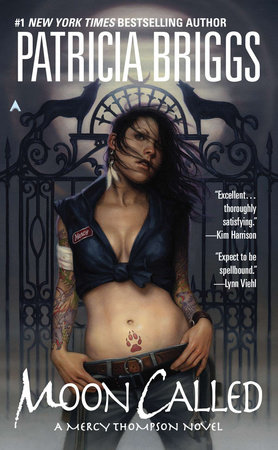
So… yeah. Lot to work with here. Strap in, folks, because this book is a doozy and I was at least half-serious about that blog title; this is an urban fantasy novel where werewolves live among us in secret, organized into packs around an Alpha, who is the most dominant wolf around, and who regularly needs to dominate the other men in his pack to keep them in line and keep them from losing control to the beast and killing someone. Also there’s a spinoff series called Alpha and Omega about a type of wolf called an Omega that is neither dominant nor submissive. Hmmmmmm. How very interesting.
We’ve got a lot of ground to cover.
But before all that, I should probably get around to tell you what the hell “Lucid Circle Book Club” means. In short, I want to start writing a weekly column about what I’ve been reading that week, as an excuse to do some nonfiction writing and chew on books I’ve read, and as something to motivate me to read more and work through a very long list of fantasy novels I’ve been meaning to get to. So, let’s consider this post a syllabus, as well, for the likely next few months of blog posts (if I can keep to this schedule I’ve spontaneously decided on).
The Reading List:
- Mercy Thompson (by Patricia Briggs)
- The Hollows (by Kim Harrison)
- Kushiel’s Dart (by Jacqueline Carey)
- Maidens of the Fall (by Hazel Young)
- Daniel Faust, Harmony Black, Moonlight Medic, Twisted Luck, Court of Chains, Kitty Norville, Anita Blake, Kate Daniels, October Daye, Seanan McGuire, and whatever else I get recommended. Some of those are books, some of those are authors, I’ll sort it out later!!
Moon Called’s opening pages are… messy.
We’re quickly told a number of things. We’re assured that our mechanic protagonist, Mercy, couldn’t possibly be as strong as a man, but she has smaller hands to make up for it. We meet a boy looking for cash that Mercy would suspect of being an “illegal” if not for his “white-bread American” looks. We learn that Mercy is a “skinwalker,” which she tells us is the name that the settlers gave her kind. We meet an undercover cop who is described as looking like “a recruitment poster for one of the local Hispanic gangs.” You see, our undercover cop has mastered the “hip-swaggering walk common to handsome young Hispanic males,” though we’re assured that he can also channel the “nervous energy of a drug addict.”
It’s. It’s a lot. The hits just keep coming. Aside from all of that flying around, we do learn a few relevant details. Mercy can smell werewolves, which are defined by violence and dominance, and she knows a whole heck of a lot about specifically European cars. Her neighbor is the local Alpha. She has a cat. Mercy is sassy but ultimately bows her head to the powerful men in her life. She likes to drive out to the wilderness, turn into a coyote, and run around chasing prey. She has Opinions(tm) about church.
Let’s set all of that aside for a moment and talk about setting.
The Mercy Thompson books take place in a version of Earth that is just now discovering the existence of supernatural creatures. It was formerly a masquerade setting, one where the supernatural exists alongside our own history in secret, until the advent of modern technology led the most powerful of those supernatural creatures to engineer an end to that masquerade. The fae put forward one of their own, using his innocent demeanor to convince the world that they were still your friendly neighbors.
They didn’t mention all the less friendly neighbors living in the shadows with them. Werewolves are still secret, and there are also vampires and witches engaging in complex politics beneath the urban facade of… the Tri-Cities area in Washington state? Huh. Sure, okay.
So the fae are public, but most other things aren’t, and this creates gray areas for the supernatural to operate in. Werewolves are certainly going to go public eventually, but right now they need to pay witches to clean up after their messes. We’re told that the fae face a lot of bigotry, which Mercy condemns, and there are religious figures proclaiming them demons and hellspawn.
The way the different supernaturals are organized is interesting. Wolves form packs because of yaoi D/s appeal, but the story presents it as a necessity born of their tendency to go “moonstruck” and turn feral. Feral wolves need to be controlled by more dominant wolves, who inevitably form a pack around themselves where all the other wolves mostly keep each other in line and bow their heads to the Alpha. These wolves are otherwise integrated into normal society, being convenience store workers, doctors, and whatever else they can find.
Vampires are a different matter. They’re all weird in a way that the werewolves aren’t. Like… I’m going to try not to do too many quote blocks, but this one just has to be read. Mercy gets a call from her vampire friend, Stefan, about a lead in the case.
“Mercy, can you hear me now?” Stefan’s voice was overly crisp and even.
“Yes,” I said. I could also hear the woman’s voice that said sweetly, “Ask her, Stefan.”
He sucked in his breath as if the unknown woman had done something that hurt.
“Is there a strange werewolf with you at Uncle Mike’s?” he asked.
“Yes,” I said, looking around. I couldn’t smell anything like Stefan nearby, and I was pretty certain I’d have noticed. The vampires must have a contact at Uncle Mike’s, someone who could tell Samuel was a werewolf and who knew Adam’s werewolves.
“My mistress wonders that she was not informed of a visitor.”
“The wolves don’t ask permission to travel here, not from your seethe,” I told him. “Adam knows.”
“Adam has disappeared, leaving his pack leaderless,” they spoke together, his words so tight on the end of hers that he sounded like an echo. I was relatively certain that she didn’t know I could hear her–though Stefan did. He knew what I was because I’d shown him. Apparently he hadn’t seen fit to inform the rest of his seethe. Of course, someone as relatively powerless as I was of little interest to the vampires.
“The pack is hardly leaderless,” I said.
“The pack is weak,” they said. “And the wolves have set precedent. They paid for permission to come into our territory because we are dominant to Adam’s little pack.”
“So the new visitors have werewolves among them,” I said sharply. “They are not Bran’s wolves. They cannot be a pack. They are less than nothing. Outlaws with no status. I killed two of them myself, and Adam killed another two. And you know I am no great power. Real wolves, wolves who were pack, would never have fallen to something as weak as I.” That was the truth, and I hoped they both could hear it.
There was a long pause. I could hear murmuring in the background, but I could not tell what they said.
“Perhaps that is so,” Stefan said at last, sounding tired. “Bring your wolf and come to us. We’ll determine if he needs a visitor’s pass. If not, we see no reason not to tell you what we know of these outlaws who are so much less than pack.”
There’s a lot to unpack here. The vibes are immaculate. Weird dommy vampire nonsense? Hell yeah. Urban fantasy politics? Awesome. The vampires have a protection racket for all the local businesses and control a bank that collects that money for them. They’re organized around a central dominant figure, same as the wolves, but it’s a Mistress instead of an Alpha, and she’s ethereal and unsettling and beautiful.
The fae, meanwhile have a kind of diaspora vibe, forming scattered communities of very different creatures brought together by their single unifying experience. Everyone’s a diaspora, a bit, since most of these supernatural creatures originate in Europe and migrated over. Mercy’s line, the skinwalkers, are the exception to this rule. Apparently, most of the other native supernaturals were exterminated by Europeans.
I’m trying to take lessons from this book. It has problems, but it’s an urban fantasy series from the early 2000s that got enough books for me to pay attention. Is it trash? Probably. But we can learn from trash. Trash still does things right. Who am I to say I’m any better than this author? I’m not! I’m certainly not more successful, so let’s set the ego aside and play the student.
Something I enjoy is how insular many of the supernatural creatures end up feeling. Our protagonist knows a lot about werewolves because she was raised by werewolves; more than her own kind, of which she’s never met another. She tries to avoid vampires, so she doesn’t know much about them (she muses her knowledge all comes from movies), and she has to learn about them from a worldly fae that knows a little something about everything.
Mercy keeps her guns loaded with silver bullets. She has good relations with the local werewolves, but her experience with werewolves means she’s experienced with the kinds of disasters that can happen when you let your guard down around bloodthirsty beasts. Any werewolf can become a threat to your life if they go moonstruck, and the only surefire way to protect yourself is to shoot them with silver.
She doesn’t expect to go up against vampires or witches, so she doesn’t carry specific countermeasures for them, though she does keep a “Lamb of God” necklace as a symbol of her faith. Turns out basically anything works for that? The Star of David is mentioned, at least, and it’s implied other things do as well. It’s Dresden Files rules, here; the strength of faith is what matters, not the specific icon.
The politics of Moon Called are very 2006 “liberal with unexamined biases.” Mercy doesn’t like bigotry, but she talks about gangs and crime in a very racial way. She thinks the church should promote love over hate. She believes in cops and the military. She’s an independent woman pursuing her own empowerment, but she’s weaker than a man and her resistance to being claimed by men is… well, it’s not that it isn’t treated seriously, but it’s just kind of hopeless. The men in her life will lay claim to her. Oh, and she’s still pining for a guy that tried to groom her into being a baby factory when she was 16 and he was 200. Cool cool cool.
Anyways, the single character treated most sympathetically by the narrative is Warren, a gay man who saves women from abusive relationships and is deeply in love with his lawyer boyfriend. The narrative is very disgruntled that anyone would discriminate against someone for being gay, and this is part of its larger criticism of various structures for being outdated on rights and liberation.
It also has stuff to say about werewolves, for whatever that’s worth. Werewolves in this setting are powerful, they’re immortal, and they die a lot because the wolf makes them stupid. The machismo energy of the wolf is responsible for most immortal werewolves dying within 10 years of being turned. They get in unnecessary fights and die. They engage in pointless dominance struggles and die. They overestimate their chances and die.
So, maybe we’ve got a thesis here. Maybe there’s some gender politics worth paying attention to. The way that women have to navigate the world of men, striking just the right balance of appeasement and pushing back to escape unscathed with agency intact. Knowing that at any time, the violence could come out and end that precious balance.
One of the love interests has a daughter that gets kidnapped, humiliated, and threatened with rape. That sequence is played for the greatest horror in the novel, and the perpetrator is one of the few characters to be explicitly killed by the end of the book, along with the ultimate culprit of the mystery plot. There’s another character that Mercy distrusts for his reputation as a serial rapist in another part of the world, but he ends up exonerated by the end of the story after saving the protagonists.
I still don’t entirely know how to feel about this book. I think it was effective, and compelling enough to get me through to the end. I don’t really care about the actual plot of the book, but the characters were interesting. The world is interesting.
Oh, but the protagonist never fucks either of the hot werewolf men that are clearly attracted to her, which, I’m fine with in the case of the 200-year-old groomer, but the other guy… actually, okay, he was in Vietnam, so I think she should just move cities and find a different pair of hot werewolves to lust after her.
6/10, could have been reading vampire porn.